

Contents
As the cannabis industry matures, quality standards are shifting beyond potency and terpene profiles. For commercial growers, cultivating on a large scale, the topic of cannabis microbial testing is becoming increasingly significant.
‘Microbial’ refers to the bacterium causing disease or health effects related to a micro-organism. For vulnerable individuals – those who are immune compromised, dealing with asthma, or undergoing chemotherapy – even small amounts of microbial contamination can cause serious health risks.
Why are Commercial Cultivators focused on microbial levels?
Commercial legal cannabis cultivators are being held to strict testing standards. In many legal markets, products must pass microbial screening before they can be sold to recreational suppliers and particularly pharma-grade medical suppliers. These tests measure levels of:
- Mold and mildew
- Yeast
- Aspergillus and other pathogenic fungi
- Bacteria that can grow during cultivation or drying
Not all contamination is visible and a flower that looks and smells healthy can still exceed allowable microbial limits. This gap between appearance and safety is a key reason the industry is taking cannabis microbial testing seriously.
Why Commercial Growers Are Paying Attention
It is no surprise that once cannabis achieves legal market status that regulations and guidelines are put in place to establish the integrity of the product and protect consumers. Licensed producers are legally obligated to provide safe, clean cannabis i.e. acceptable microbial levels in cannabis products.
Microbial contamination can occur at several points, including:
- During cloning and early plant propagation
- In high humidity grow environments
- Through contaminated tools and trimming equipment
- During the drying and curing process
- From improper storage conditions
To counter the microbial threat most grow facilities now invest in:
- Controlled airflow systems and HEPA (High Efficiency Particulate Air) filtration
- Environmental monitoring sensors
- Strict trimming and drying hygiene protocols
How Cannabis Is Tested for Microbes
When cannabis is tested for safety, labs look for how many microbes are present and what types they are. This works very similarly to how food or herbal medicines are tested. Here are the main types of tests labs carry out on cannabis samples to identify microbial levels present in cannabis flowers:
Total Microbial Counts (TAMC & TYMC)
Think of this as a “population count”:
- TAMC = Total Aerobic Microbial Count (bacteria that grow with oxygen)
- TYMC = Total Yeast and Mold Count
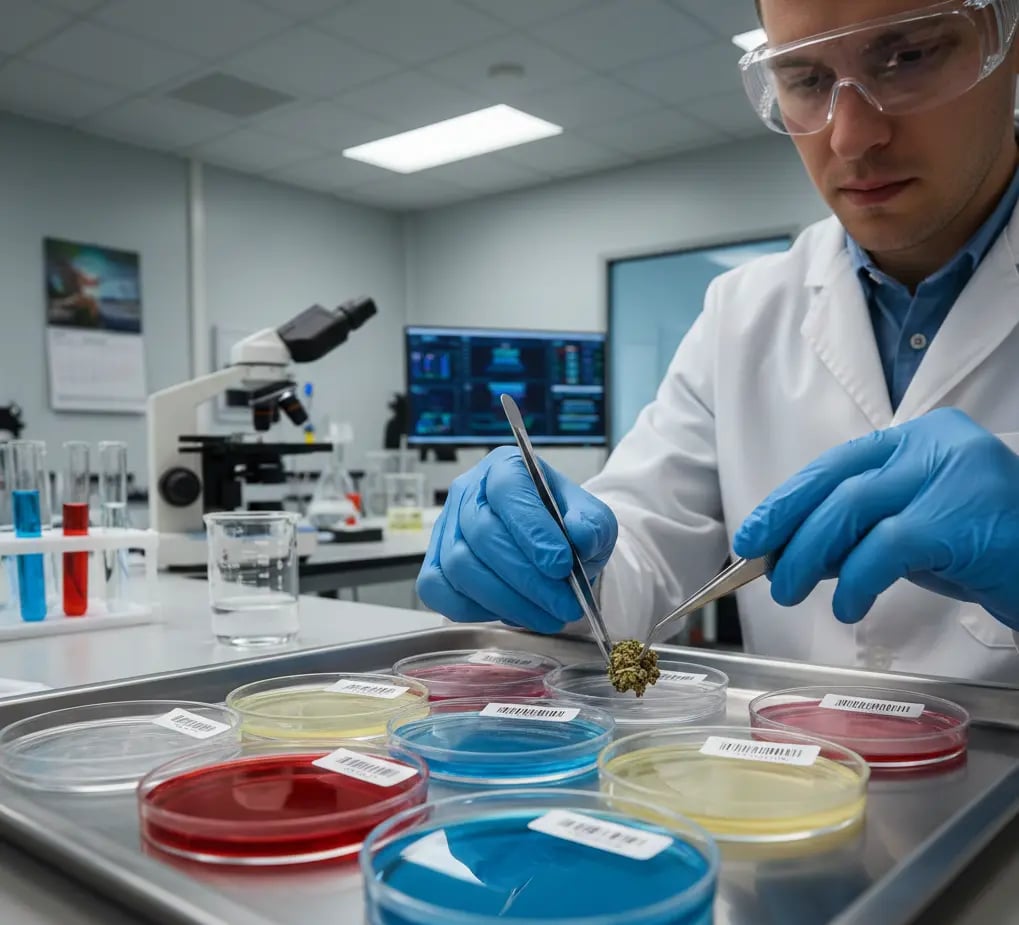
For cannabis microbial testing, labs take a small sample of ground flower, place it on special plates, and see how many colonies grow. The result is shown as CFU/g – colony-forming units per gram.
Why it matters
High total counts mean the flower was either grown, dried, or stored in conditions that allowed microbes to grow. Even if they’re not dangerous pathogens, too many microbes can indicate poor-quality handling and can spoil the product faster.
Specific Pathogen Tests
This is more like criminal background checks, in terms of why these are conducted i.e. looking for specific dangerous microbes.
Labs check for particular organisms that are known to harm humans. These tests use either special culture plates or PCR testing (a DNA-based method also used in medical labs). Common microbes that tests will target include:
Aspergillus species (can cause lung infections)
- Salmonella
- E. coli
- Certain toxin-producing molds
Why it matters
Some microbes can be inhaled deep into the lungs and cause serious infections. Regulators want to ensure none of these are present at all.
Mycotoxin Testing
Some molds produce toxins that heat does not destroy. Labs use chemical analysis (like LC-MS/MS) to detect these toxins.
Why it matters
Even if the mold is dead, the toxins can remain, so this test ensures the cannabis is free from harmful byproducts.
What Microbial Limits Are Allowed in Medical/Pharma-Grade Cannabis?
Different countries set their own rules, but most follow pharmaceutical standards for herbal medicines. Nevertheless, this overview gives a sense of the big picture in regards to microbial limits set for medical and pharma grade cannabis.
What are official testing limits for Microbials?
With cannabis microbial testing, Total microbial counts (TAMC and TYMC) are allowed, but only within limits. This means that pharma-grade medical cannabis does not need to be completely microbe-free, reflecting the universal fact that plants naturally live in microbial environments. Therefore, some microbes are expected.
Typical allowed ranges for legal medical markets are roughly:
- Total bacteria (TAMC): up to around 10,000–100,000 CFU/g
- Yeast and mold (TYMC): up to around 1,000–10,000 CFU/g
These numbers vary depending on the country and whether the product is meant to be inhaled or taken orally. Inhaled products almost always have tighter limits because microbes go straight to the lungs.
‘Zero Tolerance’ to Specific Microbes
Some microbes carry significant potential for harm and therefore must be at zero tolerance for cannabis to qualify as pharma-grade. If the end user is a medical cannabis patient, then it is likely their immune system will be compromised, and even a small amount of these microbes poses a health risk.
The list of these harmful microbes includes:
- Aspergillus (A. flavus, A. niger, A. terreus, A. fumigatus)
- Salmonella
- E. coli
- Certain toxin-producing molds
2024 Cannabis Flower Monograph
An example of the approach used by regulators towards cannabis microbial testing
can be found in the framework of the European Pharmacopoeia Cannabis Flower Monograph which was published in 2024.
Pharmacopeial monographs are medical preparation descriptions which identify quality standards in medicines. They are used as a benchmark by regulators seeking assurances on whether a medicinal product can be legally marketed to consumers.
The 2024 monograph is one of the newest and most influential standards regarding the treatment of microbes in commercially grown cannabis. As its publication coincided with the legalization of cannabis in one of Europe’s biggest countries – Germany – it has a timely significance.
Key takeaways from the 2024 monograph are:
- To use existing pharmaceutical microbial guidelines depending on the route of administration (inhalation = stricter).
- Pathogens like Salmonella, E. coli, and Aspergillus must be absent.
- Total microbial levels must fall within the accepted pharmacopeial limits (with numbers varying by category).
This has pushed growers globally to tighten their drying and storage protocols, and in many cases prompted the adoption of post-harvest remediation (treatment of harvested flower by irradiation to destroy potential toxins).
Conclusion
Cannabis microbial testing is part of the regulatory structure of legal supply routes of cannabis products to the end consumer. Safeguarding consumer interests is a legal obligation, therefore testing is necessary to fulfill those requirements.
However, this ‘safe product’ only accounts for a limited percentage of global cannabis supply. Due to the illegality of cannabis in many countries, the emphasis is on homegrowers to adopt good practice approaches to minimize Reduce the Risk of Homegrown Contamination.