

Contents
Fimming and topping are two of the simplest ways to train a cannabis plant. Both mean one cut to the growing tip during the vegetative stage, so the plant stops putting everything into one main stem and grows into a shorter, bushier shape with more main colas. Topping removes the whole tip just above a node and gives you two even new tops. Fimming (FIM) removes about 70-80% of the newest growth and usually gives you four or more new tops, with less stress. This guide covers where to cut, when to do it, how many times, and the mistakes to avoid.
Fimming vs topping at a glance
| Topping | Fimming (FIM) | |
|---|---|---|
| What you cut | The whole growing tip, just above a node | About 70-80% of the newest growth, leaving 20-30% |
| New main tops | 2, even and predictable | Usually 4, sometimes more, less even |
| Effect on height | Clear reduction | Smaller reduction |
| Recovery | About 5-7 days | A few days |
| Best time | 5-8 nodes, never fewer than 4 | 6-8 nodes, never fewer than 4 |
| Repeatable? | Yes, usually 1-3 rounds | Yes, on new main shoots |
| Best for | An even canopy, SCROG, low ceilings | A bushy plant with less stress |
| Risk | Low on a healthy plant | Low, but results vary |
What is fimming?
Fimming is a pruning technique where you cut away most, but not all, of the newest growth at the top of the plant. FIM stands for “F**k, I missed”: the technique was discovered by growers whose topping cuts went wrong and left part of the tip behind. Those plants grew back with four or more new tops instead of two, and the “mistake” became a technique of its own.
What is topping?
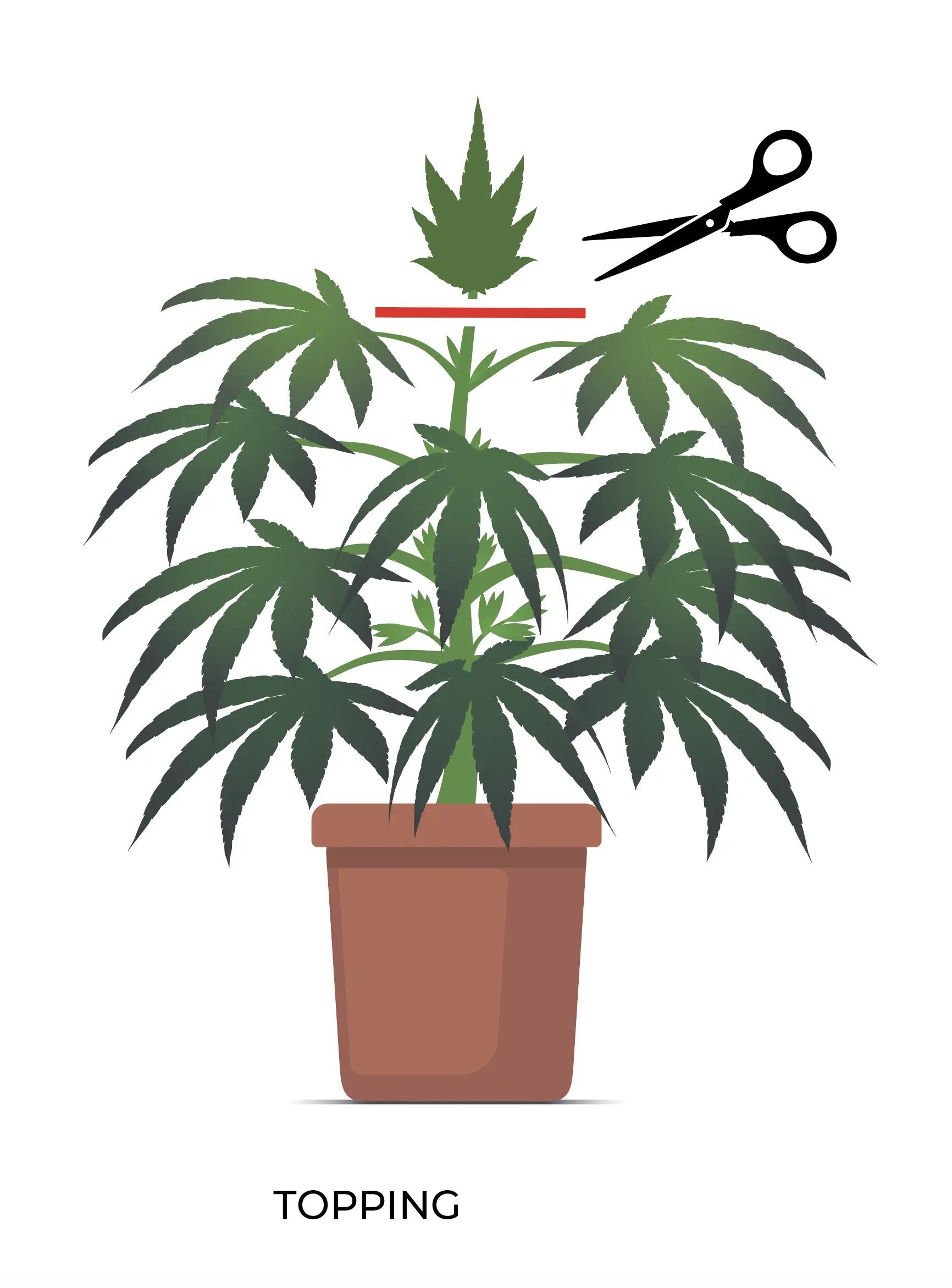
Topping means cutting off the main growing tip just above a node. The two side shoots at that node take over and grow into two equal main stems, so one big cola becomes two. It’s the most predictable way to create an even canopy, which is why it’s the base of most SCROG and mainlining setups.
Cannabis plants and apical dominance
Both techniques work because of apical dominance: left alone, a cannabis plant grows one dominant central stem. The growth hormone auxin, produced in the top shoot, drives that vertical growth, and it’s the same hormone behind the stretch after you switch the lights to 12/12.
Cutting the top shoot interrupts the flow of auxin. Topping stops it at that point for good, so the two side shoots below grow as a symmetrical pair. Fimming only disrupts it for a while, so the remaining part of the tip regrows and the plant pushes several new shoots at once.
Where to FIM a cannabis plant
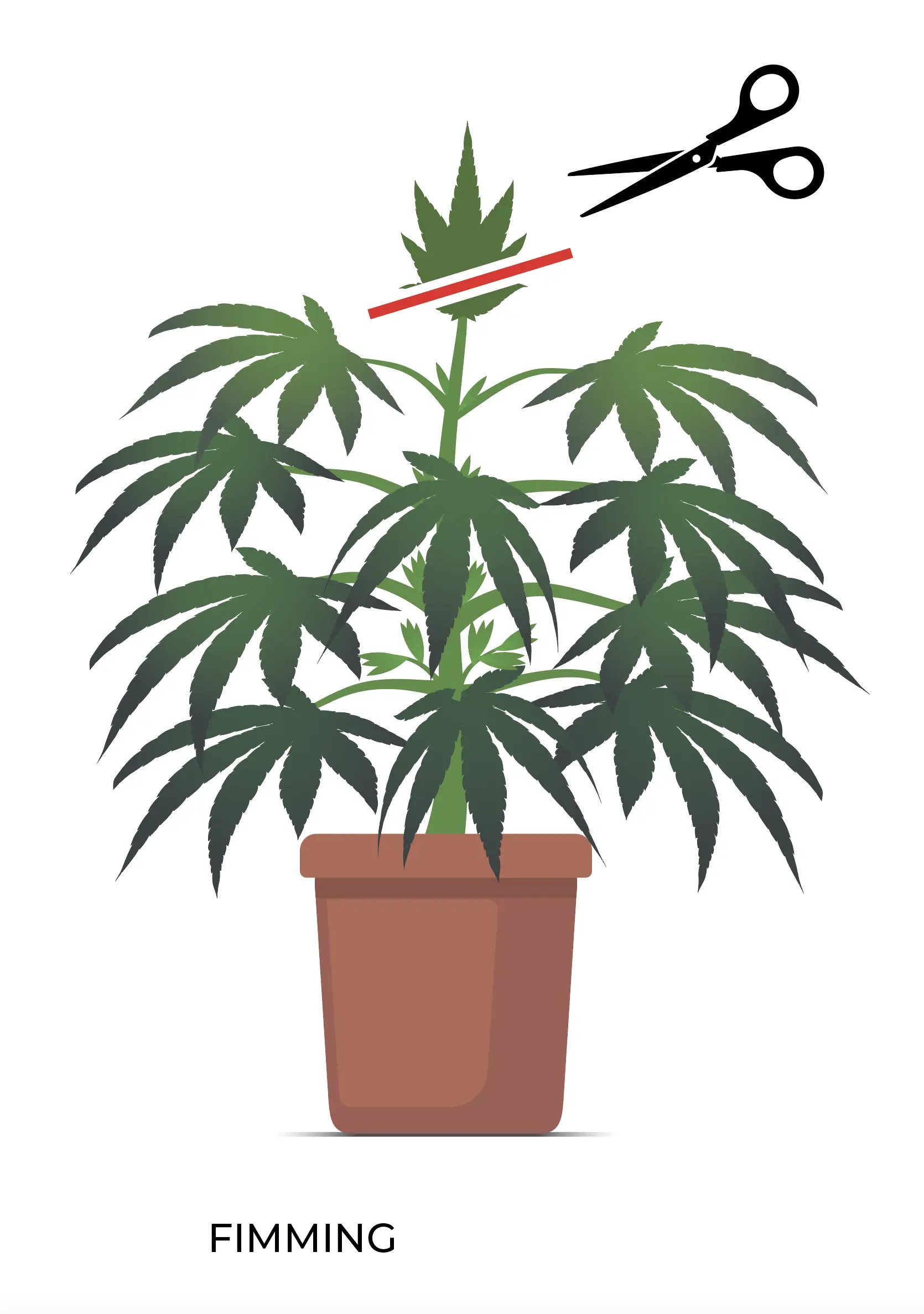
Look at the very top of the plant, at the small cluster of new leaves still folded together in the middle. That cluster is what you cut.
- Gently pinch the cluster together between finger and thumb.
- Cut straight across about 70-80% of the way down, so 20-30% of the new growth stays on the plant.
- Don’t cut into the stem or the node below. If you cut too low you’ve topped the plant; too high and nothing much happens.
Where to top a cannabis plant
Follow the main stem up to the newest node, where two small side shoots grow from the leaf joints. Cut the main stem just above that node, so both side shoots stay intact. Many growers top above the 3rd, 4th or 5th node, which keeps the plant low and the new tops close to the light.
When to FIM or top cannabis
- Node count: wait until the plant has 5-8 nodes and never fewer than 4. Under 18/6 that’s usually 3-5 weeks after sprouting.
- Health: only cut a vigorous, healthy plant with good leaf colour. A stressed plant recovers slowly.
- Timing before flowering: make the last cut at least 1-2 weeks before you switch the lights to 12/12, so the plant has fully recovered when flowering starts.
- Between rounds: wait until the new shoots have 2-3 nodes of their own before cutting again.
How to FIM cannabis, step by step
- Clean your scissors. Use a sharp pair and wipe the blades with alcohol.
- Wait for 6-8 nodes (and no fewer than 4). Find the newest growth at the top of the plant and pinch the two youngest leaves together between finger and thumb.
- Make one clean horizontal cut that removes about 70% of the top shoot and leaves a small part of the leaves behind. Sharp scissors give a clean cut instead of a crushed one.
- Leave the rest alone. New growth appears within about a week, and the plant returns to vertical growth with several new shoots.
- Repeat if you want a bigger plant. You can FIM again on the new main shoots. Several rounds over a long 18/6 period give a very bushy plant with heavy flowering.
How to top cannabis, step by step
- Sterilise a sharp pair of scissors with rubbing alcohol.
- Wait for 5-8 nodes (and no fewer than 4). Find the main growth shoot at the top of the plant and the node where two small side shoots are growing.
- Cut the main shoot cleanly just above that node, leaving both small shoots intact.
- Give the plant a few days to recover. The two shoots start to grow outward and become two new main stems.
- Repeat if needed. Top each new main stem in turn to create an even bushier plant with more colas.
Fimming vs topping: results
Both techniques give you more main colas than an untrained plant, which usually means more bud in the same height. They differ in how controlled the result is.
The benefits of topping
- Two equal main colas that grow at the same height, for an even canopy under artificial lights.
- A clear reduction in plant height, ideal for indoor growers with limited vertical space.
- More light and airflow reaching the lower branches, which lowers the risk of mould and pests.
- It combines well with low-stress training (LST) and SCROG.
The benefits of fimming
- Usually four or more new tops from a single cut, for a bushy, thick canopy.
- Very little stress, so the plant keeps growing almost without a pause.
- A useful way to keep plants short where height is limited, though it reduces height less than topping.
- Fimming lower branches helps avoid the small popcorn buds that otherwise form low on the plant.
- It works alongside topping, pruning, tying down and supercropping on plants with a long vegetative stage.
Which to choose: top when you want a flat, predictable canopy, for example in a SCROG. FIM when you want the most tops for the least stress and don’t mind a less even result. Many growers do both on the same plant: top once early, then FIM the new main shoots.
How many times can you top or FIM a plant?
There’s no fixed limit, but every cut costs a few days of recovery. Topping doubles the main tops each round: one cut gives 2 tops, topping both gives 4, then 8. Most indoor growers stop after 1-3 rounds, since more rounds mean a longer vegetative stage. Fimming can also be repeated on each new main shoot. Whichever you choose, give the plant time to grow 2-3 new nodes between rounds, and stop at least 1-2 weeks before switching to flowering.
Can you FIM or top an autoflower?
You can, but it’s risky. Autoflowers start flowering after a set number of weeks, whatever you do, so a plant that’s still recovering from a cut loses growing time it can’t get back. If you want to try it, cut only once, early (by the third or fourth node), and only on a vigorous, healthy plant. Never top or FIM an autoflower once it shows pistils. For most autos, low-stress training gives a better canopy without the risk.
Can you top or FIM during flowering?
No. Only top or FIM during the 18/6 vegetative stage, when the plant has time to recover. Cutting the tips once a plant is making buds causes serious stress and cuts flower production. If you missed the window, use gentle bending and tying down instead.
Mistakes to avoid
- Cutting too early. A seedling with fewer than 4 nodes doesn’t have the leaf mass or roots to recover quickly.
- Using blunt or dirty scissors. A blunt blade crushes instead of cutting, and a dirty one can carry infection. Always use sharp, sterilised scissors.
- Cutting too low when fimming. Cut too far down and you’ve topped the plant instead.
- Not allowing recovery time. Stacking cuts too close together slows the plant down more than it helps.
- Cutting a stressed or unhealthy plant. Fix nutrient or climate problems first.
- Topping or fimming in flower. The plant has no time to recover, and you lose buds.
Combine them with other training
Topping and fimming change the plant’s structure. Other techniques shape it further:
- LST and HST training to spread the new tops into an even canopy.
- SOG and SCROG to fill a screen with tops of equal height.
- Mainlining, a topping method that builds a symmetrical plant with 8 or 16 main colas.
- Lollipopping to remove the lower growth that won’t make good buds.
Watch the technique in our Skunkworks Project video on topping:

Conclusion
Fimming and topping are simple, low-risk techniques as long as the plant is healthy and well established. Both rely on a single clean cut. In the vegetative stage a cannabis plant is very adaptable and recovers quickly, but it still needs that recovery time, so be patient and watch how the plant responds before you cut again.
Paradise Seeds has been breeding in Amsterdam since 1994. Start with feminized cannabis seeds that respond well to training.