

Contents
Most yield problems that look like a nutrient issue or a bad phenotype are actually a climate issue. Cannabis humidity that’s fine in vegetative growth can rot a bud in late flowering, and a VPD reading that’s healthy for a seedling will stunt a plant twice its age. This guide gives you the exact settings to hold steady at each stage: VPD, temperature, humidity, air circulation, and CO2, including how those targets shift if you’re supplementing CO2.
If you’re already seeing curling leaves, mold, or stunted growth, this page won’t diagnose it. Head to our guide on common cannabis climate issues and how to fix them instead. This page is for dialing in your settings before problems start.
VPD for Flowering (and Every Other Stage)
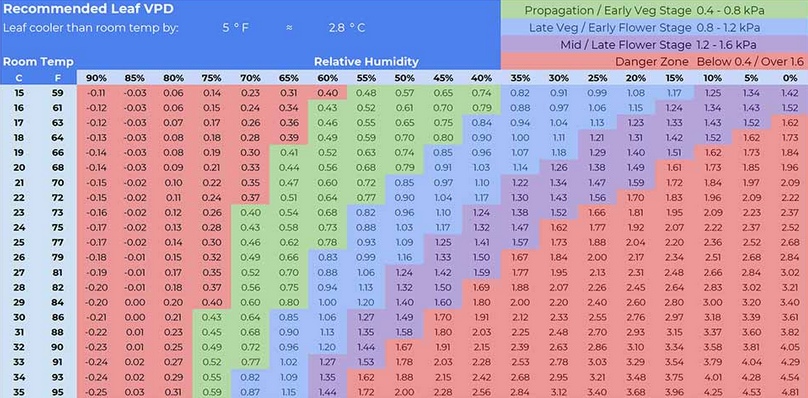
Vapor Pressure Deficit (VPD) measures the gap between how much moisture is in the air and how much the air could hold if it were fully saturated. It’s a better guide than humidity percentage alone, because the same relative humidity reading means something different at 22°C than it does at 28°C. VPD accounts for both at once.
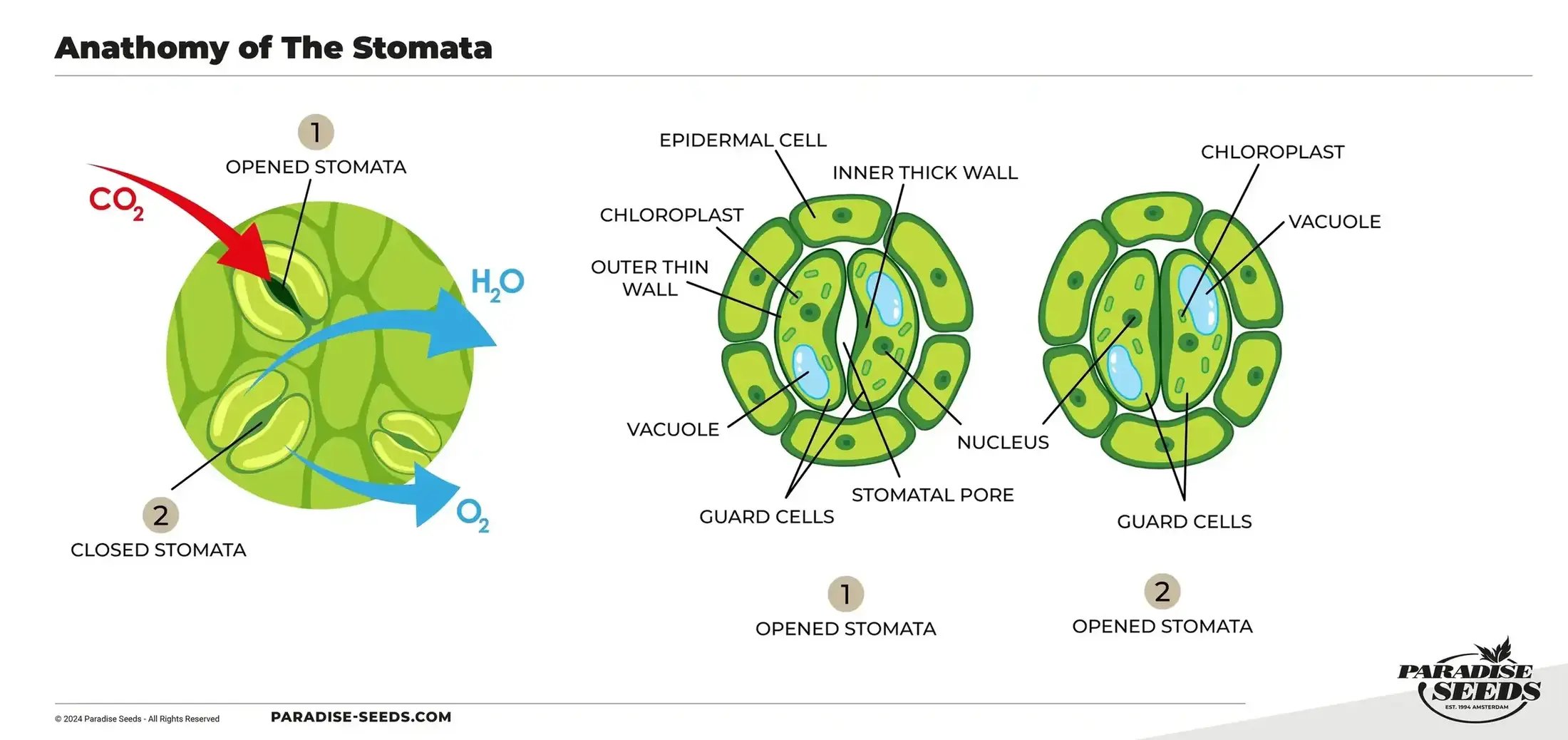
Run VPD too low and the air stays too moist for the plant to transpire properly. Nutrient uptake slows, since transpiration is part of what pulls nutrients up through the plant, and the excess moisture around the leaves raises the risk of mold and bacterial issues. Run it too high and the plant closes its stomata to conserve water, which cuts off the same pathway it needs to draw in CO2 for photosynthesis. Pushed far enough, high VPD causes visible water stress and wilting.
| Stage | VPD Target | Why |
|---|---|---|
| Seedling | 0.4-0.8 kPa | Low VPD keeps humidity high, reducing water stress while roots establish |
| Vegetative | 0.8-1.2 kPa | Supports steady transpiration and nutrient uptake |
| Early Flowering | 1.0-1.2 kPa | Balances flower formation with continued growth |
| Late Flowering | 1.2-1.6 kPa | Higher VPD dries the canopy, cutting mold and mildew risk in dense buds |
VPD for flowering is where most growers lose yield: too low and you’re fighting bud rot for the last six weeks of the grow, too high and buds finish smaller than they should. If you want to model your own room’s numbers, vpdchart.com is a solid free calculator for double-checking a reading against your grow tent’s actual temperature and humidity.
Temperature by Stage
Temperature drives how fast a plant grows and how well it finishes. Run it too hot and you accelerate vegetative growth at the cost of heat stress once the plant hits flower. Run it too cold and nutrient uptake stalls, even if your feeding schedule is correct.
| Stage | Day Temperature | Why |
|---|---|---|
| Seedling | 24-27°C | Encourages root development without stressing a fragile plant |
| Vegetative | 24-27°C | Supports strong photosynthesis and steady growth |
| Early Flowering | 24-27°C | Slightly cooler conditions push denser, more resinous buds |
| Late Flowering | 22-25°C | Cooler nights boost trichome production and protect cannabinoids and terpenes from heat degradation |
Keep swings small day to day, and keep night temperature 2-4°C below the day reading. That gap (growers call it DIF) mimics natural day-night cycles and supports tighter internode spacing. Cold nights that swing too far, on the other hand, can trigger the same nutrient lockout you’d get from a pH problem, so consistency matters more than hitting an exact number.
Flowering Stage Humidity
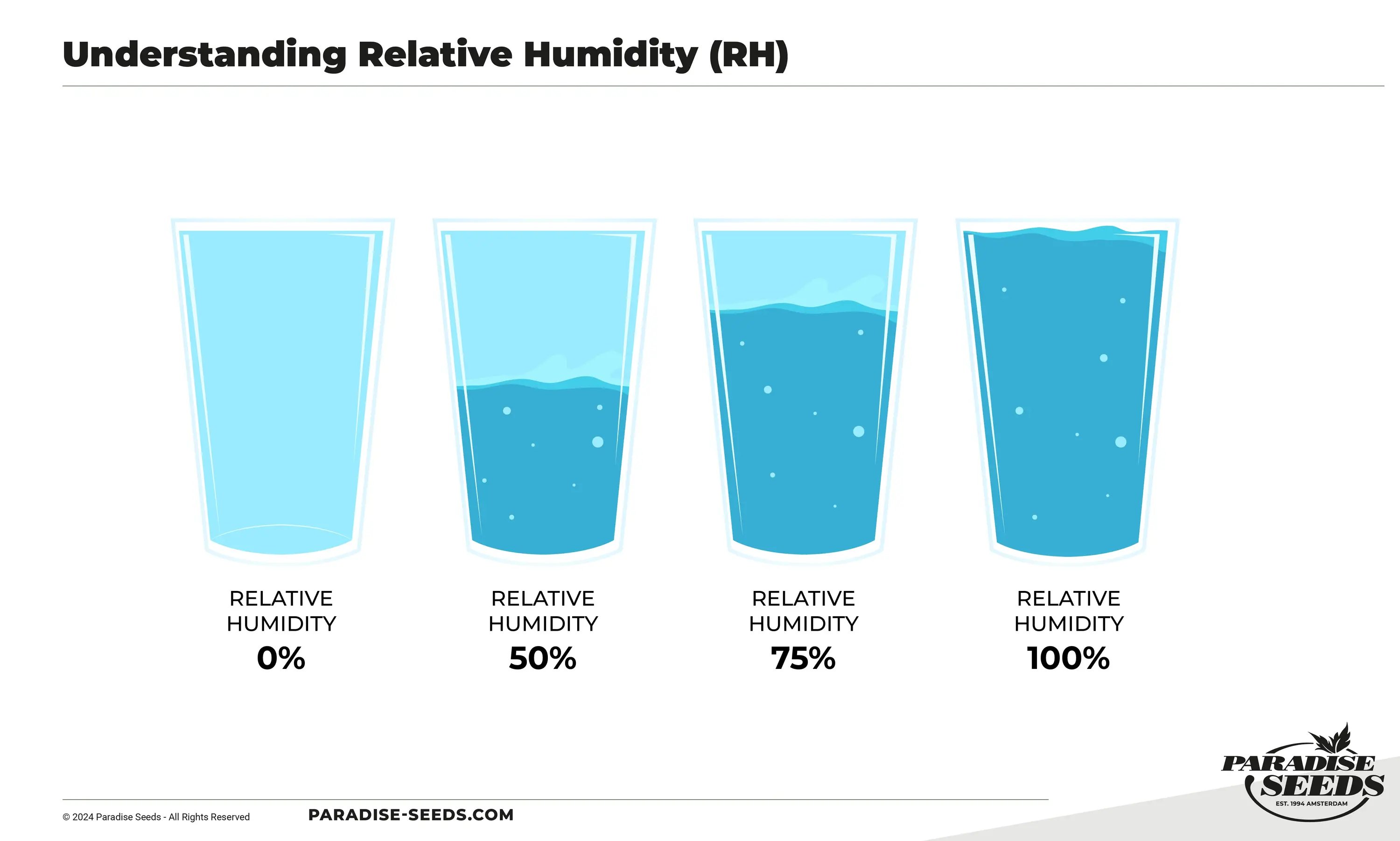
Cannabis humidity needs drop steadily as the plant matures, and nowhere does that matter more than in flowering, where dense, tightly packed buds trap moisture and become a breeding ground for mold if humidity sits too high for too long.
| Stage | Relative Humidity | Why |
|---|---|---|
| Seedling | 80-90% | High humidity prevents a young plant from drying out before roots are established |
| Vegetative | 60-80% | Supports vigorous growth without inviting mold this early |
| Early Flowering | 50-60% | Lower humidity as buds start forming reduces early mold risk |
| Late Flowering | 40-50% | The driest window of the grow, timed to protect dense buds through to harvest |
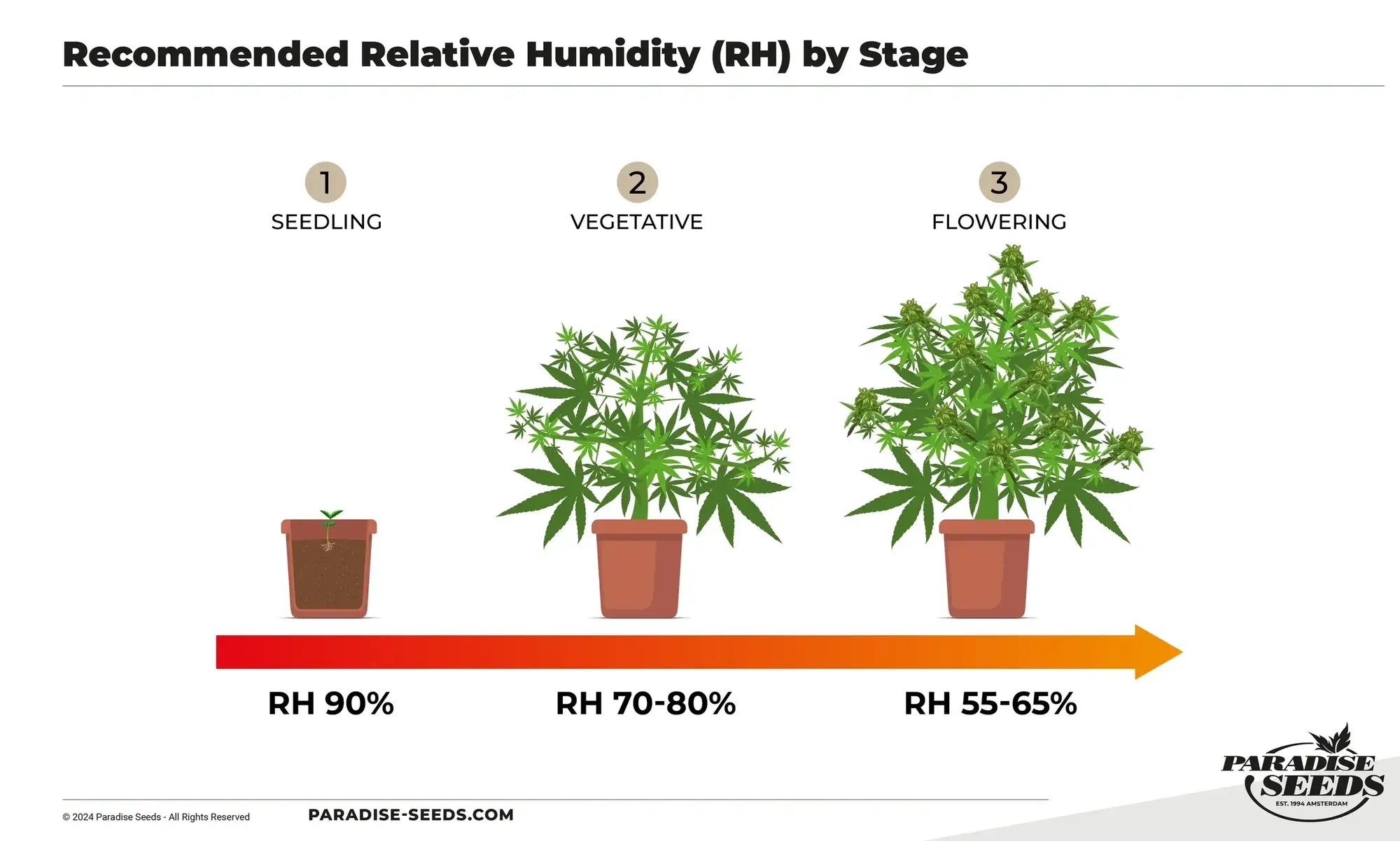
Flowering stage humidity is worth watching daily, not weekly. A single humid night during week 6 or 7, when buds are at their densest, can seed a mold problem that doesn’t show on the surface until it’s too late to save the cola.
Air Circulation
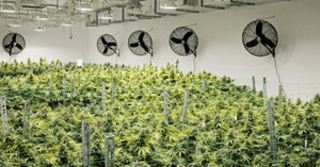
Airflow does three jobs at once: it regulates temperature and humidity around the canopy, keeps CO2 replenished at leaf level, and makes it harder for pests and mold to settle in. Seedlings need gentle, indirect airflow, just enough to prevent stagnant air without stressing a fragile stem. Vegetative plants can handle moderate, consistent airflow that reaches every part of the canopy and strengthens stems as they grow. Flowering plants need the strongest airflow of any stage, focused around and underneath the canopy to keep the densest bud sites dry. In late flowering, keep the airflow steady but avoid pointing a fan directly at buds. Strong, direct airflow that close can damage trichomes.
Good airflow also cuts down pest pressure, since still, humid air is exactly what spider mites and fungus gnats prefer.
CO2: Standard Growing vs. Growing With CO2
Cannabis grown in a standard room, with no CO2 supplementation, is working with whatever CO2 is naturally in the air, typically 400-420 PPM. That’s the bottleneck on photosynthesis once light and temperature are already dialed in: the plant simply runs out of carbon to fix before it runs out of anything else.
Supplementing CO2 up to 800-1500 PPM removes that bottleneck, and it changes more than just growth rate. With more carbon available, plants can keep their stomata open at higher temperatures without the usual water-stress penalty, which means CO2-enriched rooms can run hotter and brighter than a standard setup without the same risk of heat stress. Beyond roughly 1500 PPM, you’re past the point of added benefit, and sustained exposure above 5,000 PPM becomes a health concern for anyone working in the room, so a CO2 monitor and controller are worth the investment if you’re running enrichment.
| Setting | Standard Growing | Growing With CO2 (800-1500 PPM) |
|---|---|---|
| CO2 Level | 400-420 PPM (ambient) | 800-1500 PPM (supplemented) |
| Day Temperature (Veg) | 24-27°C | 27-30°C |
| Day Temperature (Flower) | 24-27°C early, 22-25°C late | 26-29°C early, 24-27°C late |
| VPD Target (Flowering) | 1.0-1.6 kPa | 1.2-1.8 kPa |
| Light Intensity Ceiling | Lower, CO2 becomes the limiting factor first | Higher, since more carbon is available to match increased light |
VPD Chart for Flowering: Standard vs. CO2-Enriched
Because CO₂ enrichment boosts photosynthesis and improves water-use efficiency through partial stomatal closure, plants can generally tolerate a slightly higher VPD before physiological stress becomes limiting.
| Flowering Phase | Standard VPD | CO2-Enriched VPD |
|---|---|---|
| Early Flowering | 1.0-1.2 kPa | 1.2-1.4 kPa |
| Late Flowering | 1.2-1.6 kPa | 1.4-1.8 kPa |
If you’re not running CO2 supplementation, stick to the standard column. Pushing VPD or temperature into CO2-enriched territory without the CO2 to back it up just adds heat and water stress with none of the upside.
Full Recommended Settings
| Parameter | Seedling | Vegetative | Flowering (Wk 1-3) | Flowering (Wk 4-8) |
|---|---|---|---|---|
| Day Temperature | 24-27°C | 24-27°C | 24-27°C | 22-25°C |
| Humidity | 80-90% | 60-80% | 50-60% | 40-50% |
| VPD | 0.4-0.8 kPa | 0.8-1.2 kPa | 1.0-1.2 kPa | 1.2-1.6 kPa |
| CO2 (if supplementing) | 800-1000 PPM | 800-1000 PPM | 800-1500 PPM | 800-1500 PPM |
For the lighting side of this table, our indoor grow light guide and notes on getting more out of your LEDs cover matching intensity to these same growth stages.
Get the Settings Right From the Start
We’ve been growing cannabis in Amsterdam’s own unpredictable climate since 1994, and if there’s one thing three decades in controlled and outdoor environments has taught us, it’s that consistency beats precision. A room held steady at the low end of a range will out-perform one that swings wildly around the ideal number.
For a full walkthrough of what your plant needs at each point in its life, see our cannabis growing stages guide. And if you’re setting up a new indoor room, our top 5 indoor growing recommendations is a good next stop, or browse our feminized cannabis seeds collection to start your next grow with genetics bred for consistent results.