

Contents
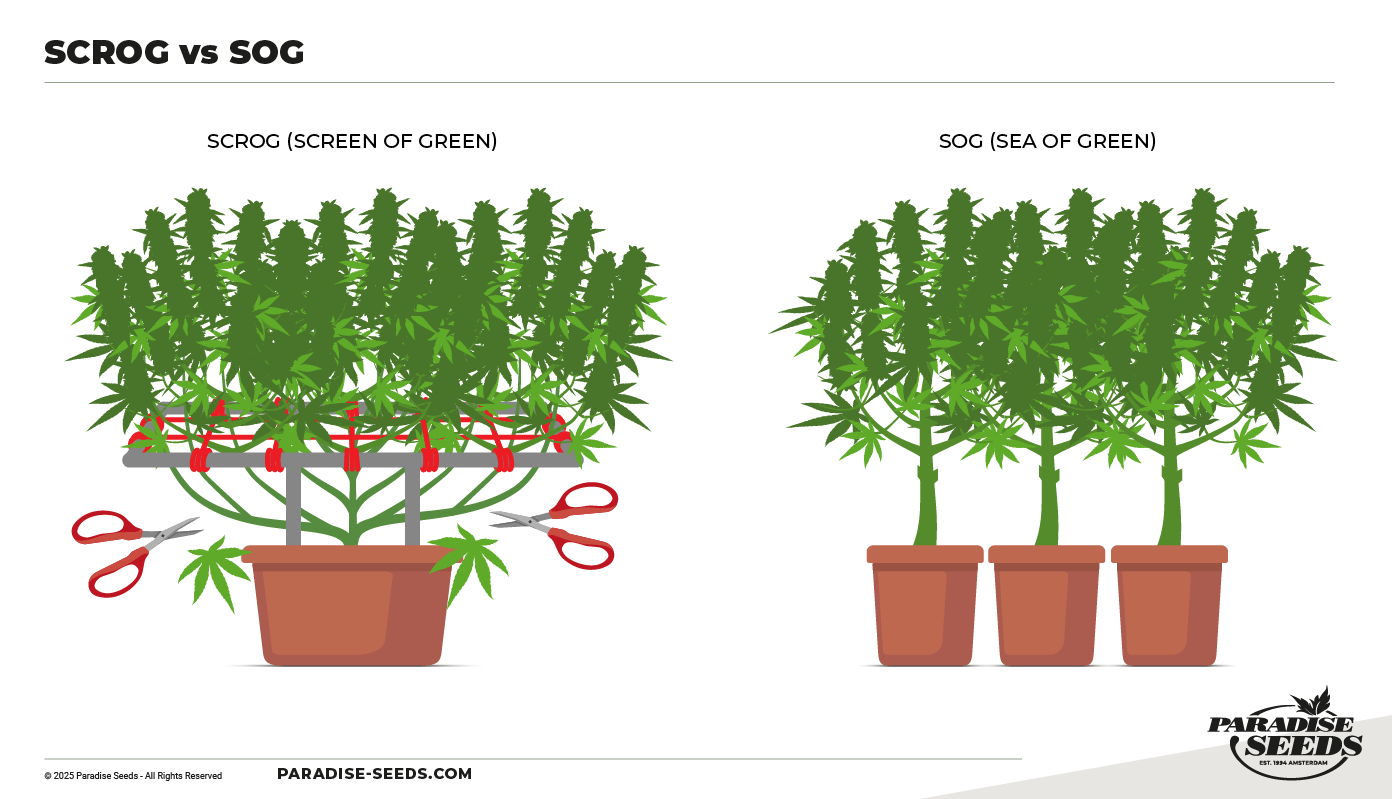
SOG (Sea of Green) and SCROG (Screen of Green) both chase the same outcome, an even, productive canopy, from opposite directions. SOG gets there with many small plants flowered early. SCROG gets there with fewer, larger plants trained flat across a screen. Both rely on the same underlying principle: cannabis responds well to training, and horizontal growth beats vertical growth for getting light to more bud sites at once. Here’s what actually separates them, and which one fits your setup.
Sea of Green (SOG)
SOG means growing a large number of small plants packed closely together, each flowered early so it produces one dominant main cola rather than a full branching structure. The result is a canopy that’s uniform in height from edge to edge. Our dedicated Sea of Green guide goes deeper into the technique if this is the direction you’re leaning.

Why growers choose it: SOG can genuinely accelerate your cycle, 8-9 weeks is achievable with the right genetics, and it makes efficient use of both space and light since every plant is small and productive rather than a handful of large ones competing for the same light source. Vegetative lighting costs drop too, since plants barely veg at all, and it’s a strong fit if height is your limiting factor. Return on investment tends to come faster than with slower, single-plant approaches.
The tradeoffs: Plant density this high raises your pest and mold risk noticeably, more plants means more opportunities for something to go wrong, and it means more plants to buy or clone upfront, a real cost consideration. Managing dozens of small plants at scale also takes real organizational discipline, this isn’t a technique that scales itself.
Setup specifics. Flip to flower once plants hit 25-30cm. From seed, run 18/6 light for just 7-10 days before flipping, rooted clones need only about 7 days. Use small pots, 7.5-10 liters, spaced roughly 30cm apart, with real aisle space left for maintenance access. Pick your genetics deliberately here: short-to-medium, indica-dominant hybrids with fast flowering times (50-55 days) are what make SOG’s speed advantage actually work. Keep flowering humidity below 40%, tighter than a standard grow, since this density needs it, and run multiple oscillating fans at different heights to keep air genuinely moving through the canopy, not just around it.

Common mistakes: oversized pots (which slow things down, the opposite of the point), the wrong genetics (long-flowering or heavily-branching strains fight the technique), weak airflow, vegging past 10 days (undermining the whole approach), and cramming plants so tight you can’t actually maintain them.
Screen of Green (SCROG)
SCROG uses a screen, a mesh net suspended above your plants, that you weave stems through as they grow, forcing horizontal spread instead of vertical growth. The canopy that develops covers the screen evenly, exposing far more bud sites to direct light than an untrained plant ever would.
Why growers choose it: SCROG gets serious yield out of relatively few plants, which matters if you’re working with plant-count limits or just don’t want to manage dozens of individuals. Light exposure improves across lower bud sites specifically, not just the top, and the more open structure genuinely improves airflow, which helps keep mold risk down even with a full canopy.
The tradeoff: SCROG is more hands-on than SOG. Weaving stems through the screen as the plant grows takes real, repeated attention to keep the canopy developing evenly and at a consistent height, this isn’t a set-and-forget technique.
Equipment. A screen with reasonably wide mesh (commercial nets work, so does a DIY build), soft garden wire for supporting individual branches, and larger containers than SOG needs, at least 12 liters, since you’re growing fewer, bigger plants. Screen height runs 25-45cm above the pot depending on the variety you’re training.
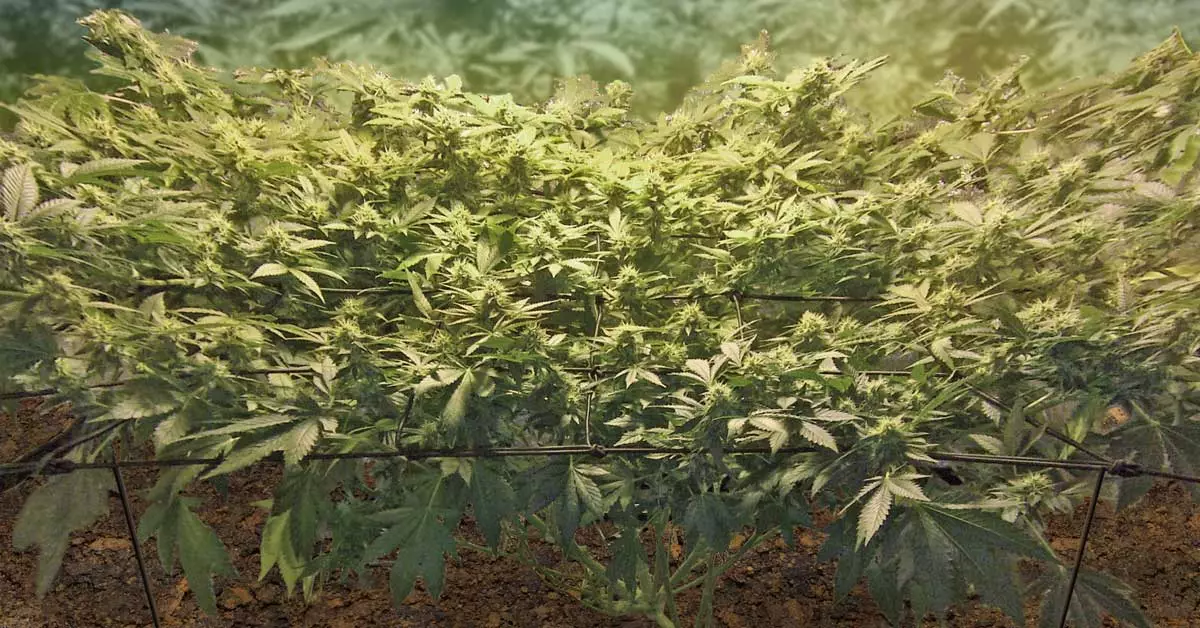
Training procedure. Top the plant around the fifth node to force lateral branching, then remove the lowest branches to focus growth upward into the screen. Start weaving once side branches reach 2-3cm above the mesh, working in different directions across the screen so the canopy fills evenly rather than bunching in one area. Use soft wire for gentle support as you go. The plant will look rough, misshapen and a little sorry for itself, for a day or two after training, that’s normal, it recovers fast.
Outdoors, SCROG earns its keep for airflow and weather resilience on top of the usual yield benefits, plus better camouflage from a lower, spread-out profile. Set the screen higher outdoors, 50-60cm, to account for the sun’s changing angle across the season. Our outdoor SCROG guide covers the outdoor-specific adjustments in full.
Which Should You Choose?
Both techniques lean on the same core principle, cannabis takes training well, and horizontal growth beats vertical for getting light where it counts, but they suit different situations. Choose SOG if speed and turnaround matter most to you, you’re working with real height restrictions, and you’re comfortable managing a larger number of individual plants. Choose SCROG if you’d rather manage fewer plants more intensively, you’re working under a plant-count limit, or you want maximum yield from a fixed, smaller footprint.
Train With a Plan
We’ve been growing and training cannabis in Amsterdam since 1994, and both of these techniques earn their reputation: done right, either one turns a standard grow into a genuinely even, high-output canopy. Pick based on your space and how hands-on you actually want to be, not just whichever technique sounds more impressive.
Ready to put either method to work? Browse our feminized cannabis seeds collection, or start with our indica-dominant hybrids if SOG’s fast-flowering approach is the direction you’re headed.