

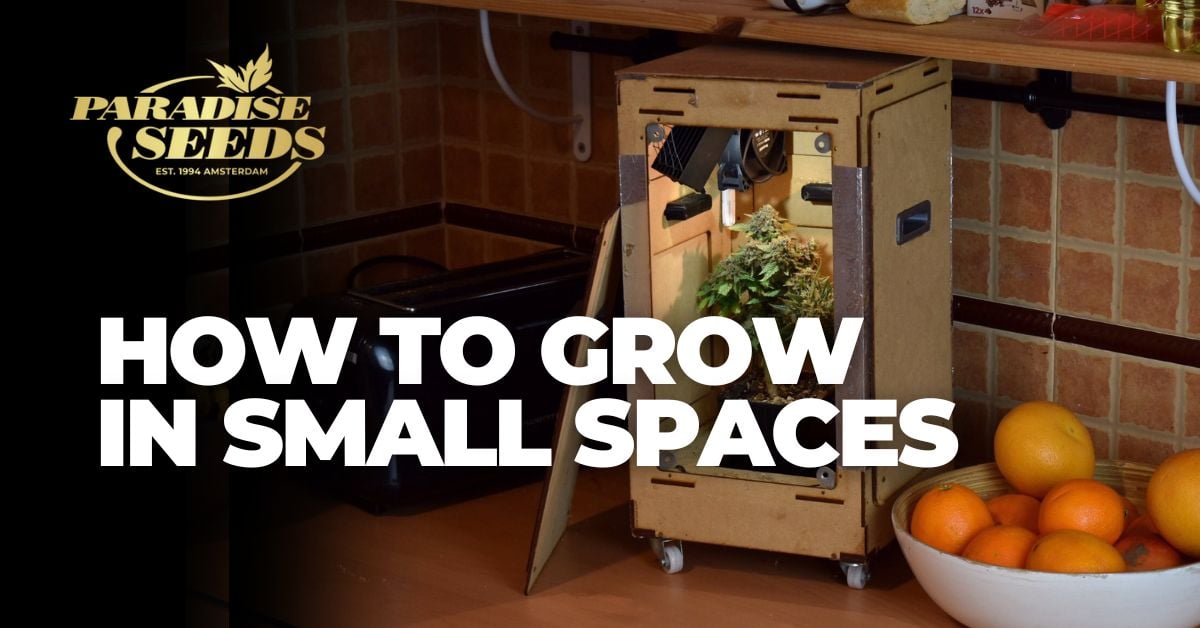
Whether you’re working with a grow tent, a converted wardrobe, or a compact spare room, limited space doesn’t have to mean limited yields. With the right training technique, small-space growers can consistently harvest impressive, dense buds. You just need to work smarter, not bigger.
Modern LED lighting has made compact growing more viable than ever. Today’s full-spectrum LEDs run cool and efficiently, which means tighter setups are practical without heat stress becoming a constant battle. Combined with the right plant training method, a small footprint can produce results that rival much larger grows.
Here we break down four of the most effective techniques for maximising yield in small spaces: SOG, SCROG, LST, and Lollipopping. Bear in mind that training improves canopy efficiency, but it works best alongside good genetics, adequate light intensity, solid environmental control, and healthy root-zone nutrition; these factors matter just as much as technique.
How to Grow Short Plants with Big Buds Indoors
To get the highest yields from a compact indoor setup, you must maximize canopy efficiency while preventing your crop from stretching. Follow these quick wins to ensure your small plants stack massive colas:
- Shorten the Vegetative Phase: Flip photoperiod plants to flower early (when they are 15–30 cm tall) to restrict vertical growth.
- Keep Lights Close: Maintain your LED grow lights at the manufacturer’s recommended distance. If lights are too far away, plants stretch and produce loose, airy buds.
- Choose Compact Genetics: Pair your training techniques with naturally short, stout Indica-dominant strains or autoflowers.
Sea of Green (SOG): Training Short Plants for Big Buds
Best for: Growers who want fast harvests and have space for multiple small pots.
Sea of Green is all about quantity over individual plant size. Instead of growing one or two large plants over a long vegetative period, a Sea of Green cannabis grow packs many smaller plants together and flips them to flower early, typically when they’re just 15-30 cm tall. By keeping vegetative time short and plant density high, each plant focuses on producing a single, massive central cola. Harvest comes faster, and the combined yield from many small plants adds up.
Key SOG Tips:
- A common starting point is around 4-9 plants per square metre of canopy, though density varies by cultivar.
- Many SOG growers flower clones after 1-2 weeks of vegetative growth; seedlings often need longer to establish before the flip.
- Use uniform, fast-flowering indica-dominant strains for the most consistent canopy.
- SOG works especially well in low-ceiling spaces because the plants stay compact. SOG is traditionally run with clones for uniformity. Paradise Seeds varieties well-suited to this method include Allkush, Sensi Star, Ice Cream, and Belladonna.
Want the complete, step-by-step blueprints? Read our definitive guide to Sea of Green cannabis cultivation for exact pot layouts and timeline strategies.
Screen of Green (SCROG) Training
Best for: Growers with a few plants who want to fill their canopy efficiently.
Screen of Green trains fewer plants to spread outward and fill the available horizontal space. A mesh screen is positioned above the pots. As the plant grows up, you tuck and weave branches through the holes to guide them horizontally. The result is a flat, even canopy where light hits every bud site at roughly the same distance.
Key SCROG Tips:
- Begin tucking when plants approach the screen, depending on your cultivar’s growth rate.
- Tuck new growth every 2-3 days during veg and continue during the initial 1-3 weeks of the flowering stretch.
- Sativa Warning: Strains with high lateral branching and heavy stretch perform well here. Try Original White Widow (IBL). If using aggressive Sativas like Atomical Haze or Dutch Dragon, flip to flower when the screen is only 40-50% full to prevent them from overwhelming a small space.
SOG vs SCROG: Confused about which “Green” method fits your specific grow tent? Check out our breakdown comparing SOG and SCROG training methods side-by-side to pick the perfect system for your micro-setup.
LST: Low Stress Training
Best for: Beginners, autoflowering strains, and anyone who wants more light penetration without high-stress techniques.
Low Stress Training is a gentle, gradual method of shaping your plant’s growth without cutting or damaging it. Young branches are bent away from the centre of the plant and secured with soft ties. This opens up the plant structure, letting light reach bud sites that would otherwise be shaded by the top canopy, creating multiple colas at roughly the same height.
Key LST Tips:
- Start LST early, when stems are young and flexible (around 3-4 weeks into veg).
- Bend gently and gradually; re-adjust every few days. Anchor ties to pot edges, not the stem itself.
- LST is widely regarded as one of the safest training methods for autoflowering varieties because it causes minimal stress and requires little recovery time.
Get the Step-by-Step Walkthrough: Ready to start tying down your plants? Read our complete guide to Low Stress Training (LST) for a breakdown of equipment, timing, and step-by-step bending methods.
Lollipopping
Best for: Any grow style where you want to concentrate energy on the top buds.
Lollipopping is a pruning technique that pairs beautifully with SOG, SCROG, or LST. It involves removing the lower branches and undergrowth of the plant, everything below the main canopy that receives little or no direct light. This stops the plant spending energy on small, airy “popcorn” buds and redirects it into the top colas, while drastically improving airflow.
Lollipopping vs Defoliating: Read the guide to Lollipopping vs Defoliating for a breakdown of when and how to use each technique.
Key Lollipopping Tips:
- A common approach is removing growth from the lower 20-30% of the plant upward.
- Pro Tip: Avoid stripping a full third of your plant all at once exactly on the day you flip the lights, as this can severely shock the plant. Instead, do a major lower cleanup 3-5 days before switching to 12/12, and a final touch-up around Day 21 of flower once the initial stretch stops.
Which Technique Is Right for You?
Here’s a quick comparison to help you decide how to manage your small footprint:
| Technique | Difficulty | Plants Needed | Best Grow Space | Works with Autos? |
| SOG | Medium | Many small pots | Wardrobes, low-ceiling cabinets | Possible, but less predictable |
| SCROG | Medium-Hard | 1–4 large plants | Grow tents, wide spaces | Not ideal |
| LST | Easy | Any quantity | Direct micro-grows, stealth boxes | Yes- Highly Recommended |
| Lollipopping | Easy | Any quantity | All compact spaces | Yes (With careful timing) |
Many experienced growers combine these methods. For example, running LST and lollipopping on autoflowers, or SCROG and lollipopping on photoperiod plants. Experiment and find what works for your setup.
Best Strains for Small Spaces
Training techniques like LST, topping, or SCROG can help maximize your canopy, but choosing the right genetics makes the job much easier. If you’re growing in a tight space, many sativa-dominant cultivars can stretch significantly during flowering, so compact varieties are often a better fit. Cultivars such as Sensi Star or Wappa are known for their relatively short, bushy growth, moderate stretch, and dense, heavy buds, making them popular choices for growers with limited vertical space.
Small Space Growing FAQs
Can you really get big buds from small plants?
Yes. By utilizing training techniques like LST, SCROG, or SOG, you force the plant to distribute its energy horizontally rather than growing a single tall stem. This exposes all hidden bud sites to direct light, allowing short, compact plants to yield heavy, rock-hard colas.
What pot size should I use for big buds in a small space?
For tight setups like cabinets or small tents, stick to fabric or air pots between 3 to 9 liters. Fabric pots prevent roots from circling and encourage a compact, dense root system. A smaller pot naturally caps the vertical stretch of your plant, but when combined with techniques like LST or Lollipopping, it still allows the plant to focus its limited energy entirely on stacking thick, dense colas.